



Sweeping institutional restructuring intensifies tensions between judiciary and executive
Four IHC Judges Prepare to Challenge 27th Constitutional Amendment
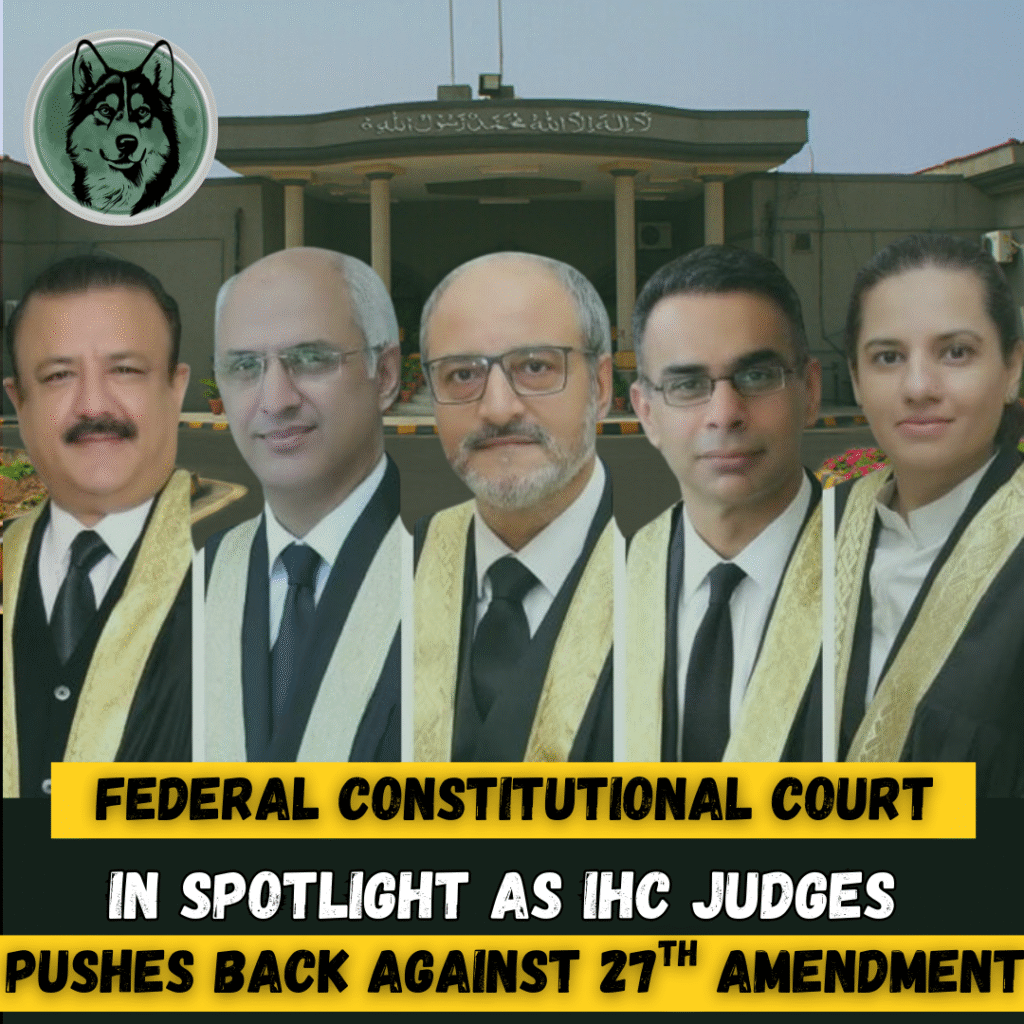
A major legal confrontation is unfolding as four judges of the Islamabad High Court prepare to challenge the controversial 27th Constitutional Amendment, a move that deepens the already escalating constitutional and institutional crisis in the country.
Sources confirm that a draft petition authored and endorsed by the judges—has been completed and forwarded to the Supreme Court for filing. The formal submission is expected soon.
Which Judges Are Challenging the Amendment?
The applicants include:
- Justice Mohsin Akhtar Kiani
- Justice Babar Sattar
- Justice Saman Rafat Imtiaz
- Justice Sardar Ejaz Ishaq Khan
These judges are collectively contesting the amendment, urging the country’s highest courts to intervene against what they consider a systemic assault on constitutional norms.
However, officials in both the Supreme Court and the newly formed Federal Constitutional Court (FCC) confirm that no petition has been received yet.
Background: Amendment Sparks Historic Backlash
The 27th Constitutional Amendment, now part of the law after presidential approval, has ignited the strongest judicial backlash in Pakistan’s recent history.
Prominent Supreme Court judges, including Justice Mansoor Ali Shah and Justice Athar Minallah, resigned in protest calling the amendment a “grave assault on the Constitution of Pakistan.”
Legal experts, opposition parties, bar councils, and retired judges have described the amendment as a direct threat to judicial independence.
What the 27th Amendment Actually Does
The amendment radically restructures Pakistan’s constitutional and institutional architecture:
1️⃣ Supreme Court Reduced, FCC Empowered
- The newly created Federal Constitutional Court becomes the supreme body for constitutional matters.
- All Supreme Court suo motu powers are abolished.
- Articles 184, 186, and 191A have been removed.
- All constitutional petitions pending before the Supreme Court will be transferred to the FCC.
2️⃣ Transfer of Judges & Forced Retirement
Revised Articles 199 and 200 allow the president—on the Judicial Commission’s recommendation to transfer high court judges between provinces.
Any judge refusing relocation is automatically retired.
3️⃣ Lifetime Immunity for the President
Under changes to Article 248, the president receives permanent legal immunity, waived only if they assume public office again.
4️⃣ Major Military Restructuring
Changes to Article 243 abolish the office of the Chairman Joint Chiefs of Staff Committee from November 27, 2025, consolidating all strategic authority under a single office: the Chief of the Defence Forces.
5️⃣ Constitutional Protection for Certain Officers
Key officers gain removal protection equivalent to Article 47 — effectively granting them presidential-level immunity.
Why Judges Are Pushing Back
The petitioning judges argue that the amendment:
- Destroys judicial independence
- Creates a parallel court superior to the Supreme Court
- Gives unchecked power to the executive
- Violates the basic constitutional structure and separation of powers
Legal scholars warn that the reforms functionally downgrade the existing judiciary, placing unprecedented authority in the hands of the executive branch.
How This Affects Pakistan
1️⃣ Judicial Instability
With senior judges resigning and others preparing legal challenges, Pakistan enters an era of internal judicial fragmentation.
2️⃣ Politicisation of Constitutional Interpretation
Creating an FCC with broad original jurisdiction shifts constitutional interpretation from an independent Supreme Court to a potentially politically influenced institution.
3️⃣ Military & Executive Power Concentration
Centralising military authority and granting lifetime presidential immunity significantly shifts Pakistan’s institutional balance.
4️⃣ Risk of Prolonged Constitutional Tug-of-War
With judges preparing petitions and others resigning, Pakistan may witness years of litigation, political crisis and institutional deadlock.