



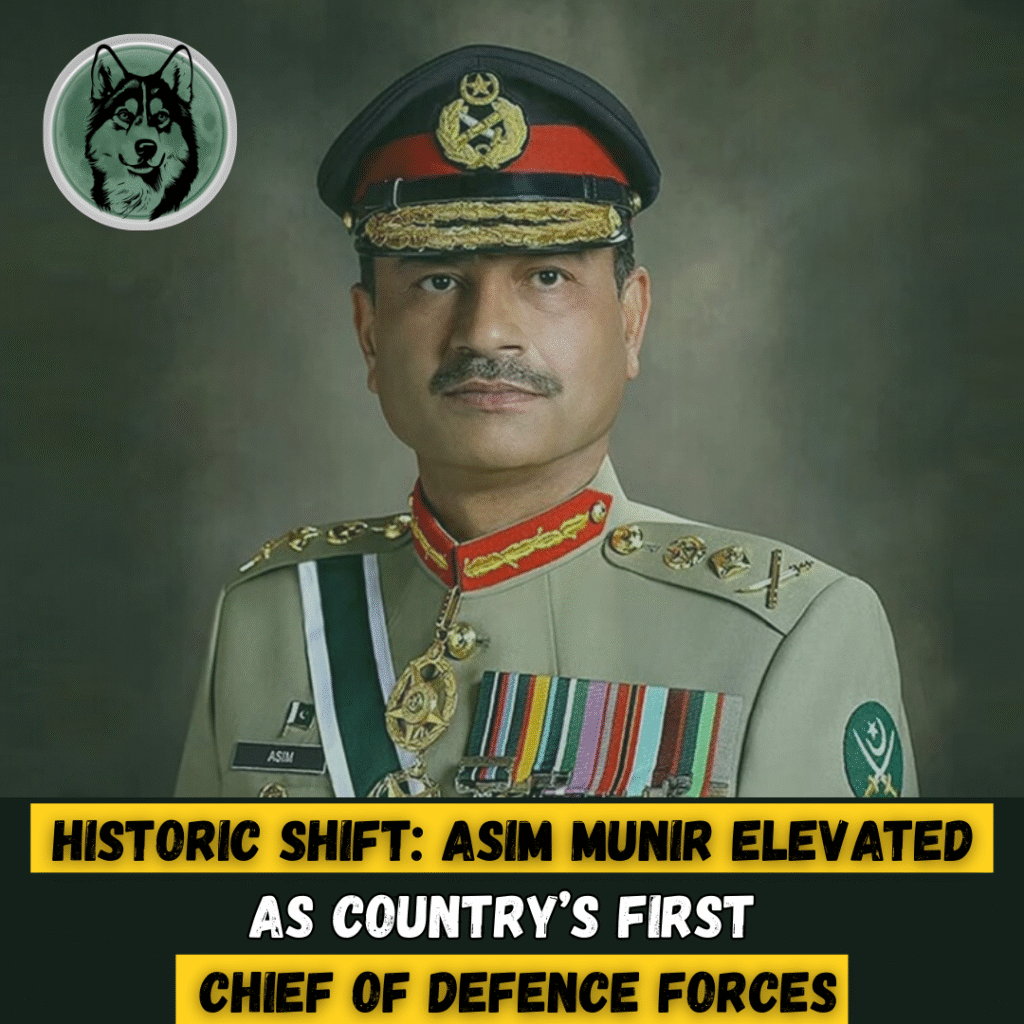
Historic military restructuring brings Asim Munir to dual roles: COAS and Chief of Defence Forces.
What Happened?
Pakistan has officially entered a new era of military command after President Asif Ali Zardari approved the appointment of Field Marshal Syed Asim Munir as the country’s first-ever Chief of Defence Forces (CDF). The Presidency confirmed that Munir will serve a five-year term, during which he will also continue as Chief of Army Staff (COAS) under a unified command structure.
Simultaneously, President Zardari granted a two-year extension to Air Chief Marshal Zaheer Ahmed Babar Sidhu, effective after he completes his current term in March 2026.
Why Is the CDF Appointment Significant?
This appointment is historic because Pakistan has never before had a centralised defence chief overseeing all service branches under a single authority. The 2024 amendments made it legally possible by:
- Increasing the Army Chief’s tenure from 3 to 5 years
- Establishing the CDF as an umbrella role
- Allowing one notification to cover both COAS and CDF positions
- Strengthening unified military coordination
This structural reform marks one of Pakistan’s most significant defence reorganisations in decades.
How Did the Notification Confusion Arise?
Speculation escalated earlier in the week due to delays in issuing the official notification.
Law Minister Azam Nazir Tarar clarified that:
- The delay was a “storm in a teacup.”
- There was no legal ambiguity under Article 243 or the Army, Navy, and Air Force Acts.
- The delay occurred only because the Prime Minister was abroad.
- Instructions have been issued to the Ministry of Defence for the transition.
The government emphasized that the President’s appointment powers are exercised strictly on the Prime Minister’s binding advice.
Where Does This Leave the Defence Structure?
Pakistan’s defence framework now stands at a major intersection:
- Asim Munir will drive strategic coordination across all branches.
- Air Chief Sidhu’s extension ensures continuity in the Pakistan Air Force’s modernization roadmap.
- The Ministry of Defence has already begun procedural adjustments to operationalize the updated framework.
With all service branches now linked more closely under a unified command, analysts expect shifts in long-term defence strategy and inter-services planning.
What This Means for Pakistan’s Power Structure
1. Civil–Military Dynamics
The CDF role centralizes unprecedented authority in the hands of one military leader.
Pros: Stronger cohesion, faster decision-making, unified doctrine.
Concerns: Potential imbalance between military and civilian oversight if not managed transparently.
2. Strategic Coordination
Pakistan has long operated with parallel service structures. A CDF could:
- Reduce duplication
- Strengthen joint operations
- Improve crisis response
3. Regional Context
Several countries like the U.S. and U.K. operate with unified defence commands led by a chairman or chief. Pakistan’s move aligns with international best practices but must adapt to its own political-military environment.
4. Political Timing
The government’s quick clarification on legal matters signals political urgency to:
- Avoid public speculation
- Control the narrative
- Prevent institutional misunderstandings