




From home décor to fashion and digital habits, style choices often reveal hidden personality traits.
Why Style Choices Are Never “Just Style”
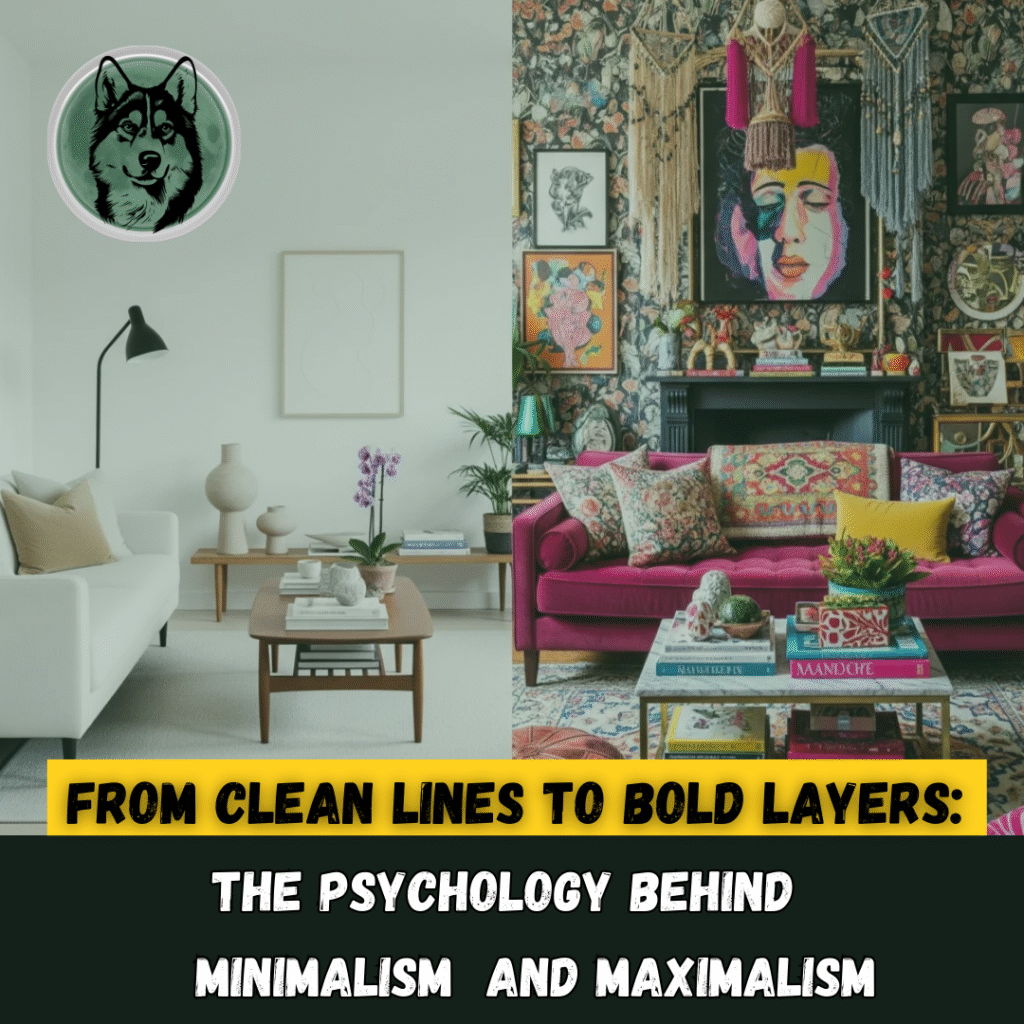
Minimalism and maximalism are often seen as design trends, but psychologists and behavioral experts argue they are expressions of personality, not passing fashions.
Whether someone prefers clean spaces with neutral tones or bold colors layered with objects, the choice reflects how the mind seeks comfort, control, stimulation, and meaning.
Our surroundings are a silent language one that reveals more about us than we often realize.
The Minimalist Mindset: Control, Clarity, and Calm
People drawn to minimalism often value clarity, structure, and emotional regulation.
Common traits associated with minimalists include:
- Preference for order and predictability
- Lower tolerance for sensory overload
- Desire for mental clarity and focus
- Strong boundaries between personal and external chaos
Minimalists often see excess as distraction. For them, fewer possessions mean more freedom, not less. Clean spaces help reduce anxiety and allow the mind to operate efficiently.
Psychologists note that minimalism is frequently chosen by individuals who cope with stress by simplifying their environment to regain control.
The Maximalist Mindset: Expression, Energy, and Identity
Maximalism, by contrast, celebrates abundance, storytelling, and emotional richness.
People who lean toward maximalism often display traits such as:
- High creativity and emotional expressiveness
- Comfort with complexity and stimulation
- Strong attachment to memories and symbolism
- Desire for individuality and narrative
For maximalists, objects are not clutter—they are extensions of identity. Each color, artwork, or item carries emotional weight. A layered space reflects a layered personality.
Psychologists suggest maximalists often thrive on external inspiration, drawing energy from their surroundings rather than simplifying them.
What Your Space Says About Your Inner World
Our environment mirrors how we process life.
- Minimalists often process internally, reflecting before reacting.
- Maximalists often process externally, engaging actively with their surroundings.
Neither approach is superior. They represent different coping mechanisms, emotional needs, and cognitive styles.
Importantly, shifts between minimalism and maximalism can signal life transitions—stress, healing, grief, growth, or reinvention.
The Myth of “Better Taste”
Society often frames minimalism as “mature” and maximalism as “messy.” Psychology rejects this idea.
Taste is not a moral ranking.
It is a psychological preference.
What feels peaceful to one person may feel empty to another. What feels inspiring to one may feel overwhelming to someone else.
The healthiest spaces are not trend-driven—they are emotionally aligned.
What Modern Psychology Concludes
Studies in environmental psychology show that people design spaces that regulate their emotions:
- Minimalists regulate through reduction
- Maximalists regulate through stimulation
Your space is not about what you own—it’s about how you want to feel.
And that feeling reveals who you are.
Final Thought
Minimalism and maximalism are not opposites.
They are languages of the self.
One whispers.
The other speaks loudly.
Both are honest.
The real question is not how your space looks but why it feels right to you.