



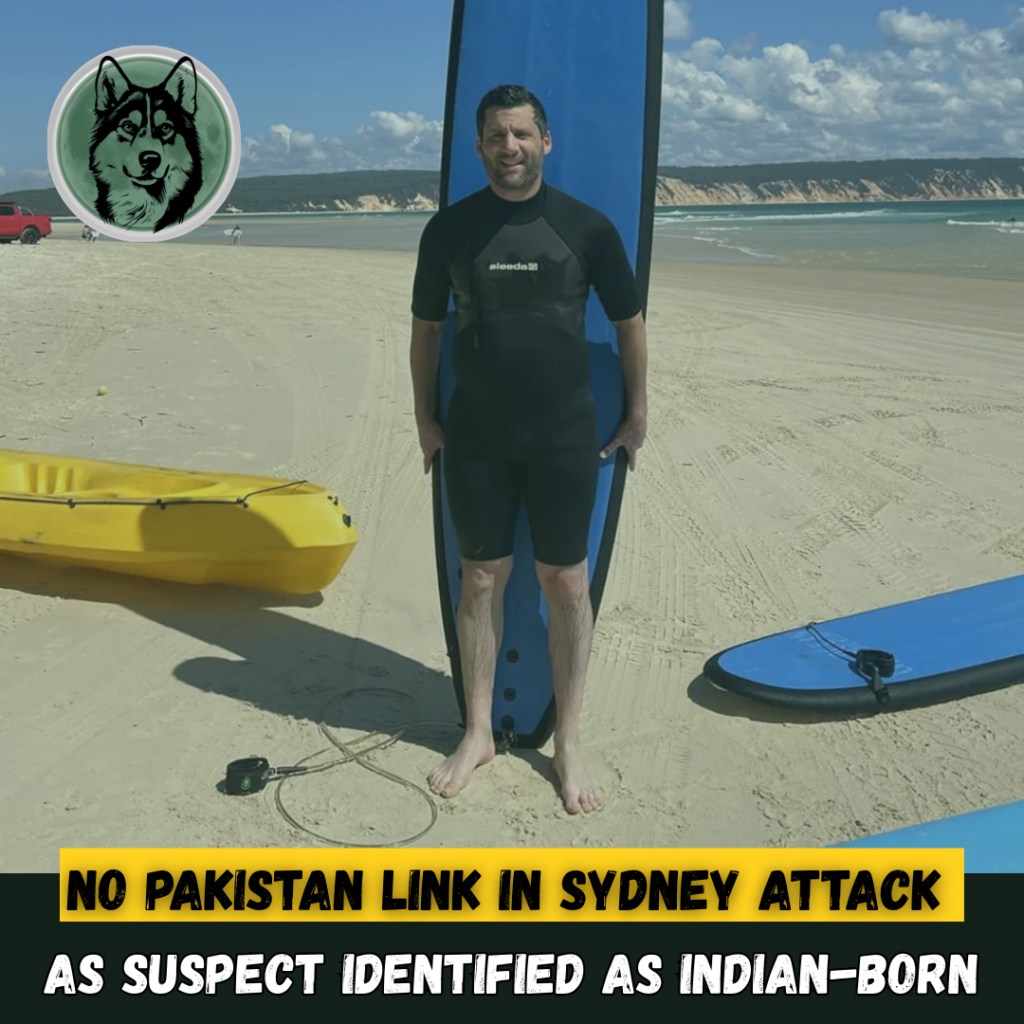
Close associate confirms suspect’s Indian origin, Italian maternal background
Attempts to link the deadly Sydney attack to Pakistan have unraveled after Australian authorities and local sources confirmed that no evidence connects the attackers to Pakistan, exposing what critics describe as a politically motivated misinformation campaign.
Investigators say there is no family, financial, or ideological network tying the suspects to Pakistan, while members of the Pakistani-Australian community have also denied any association with the accused.
Who Were the Attackers
Australian officials have confirmed that the attackers were a father and son, identified as Sajid Akram and Naveed Akram.
According to the Australian Home Affairs Minister:
- Sajid Akram arrived in Australia in 1998 on a student visa, later transitioning to a partner visa in 2001
- Naveed Akram was born and raised in Australia and is an Australian citizen by birth
A close associate of Naveed Akram told Australia’s 9 Network that Sajid Akram was Indian-born, while Naveed’s mother is Italian, contradicting early narratives attempting to associate the family with Pakistan.
Australian authorities have confirmed that both individuals held Australian citizenship.
What Authorities Have Ruled Out

Investigators stated clearly that:
- No evidence links the suspects to Pakistan
- No financial, ideological, or organizational support networks connected to Pakistan have been identified
- Pakistani-Australian community leaders were unaware of the suspects’ identities
Officials say these findings invalidate earlier claims circulating online and in some media outlets.
New CCTV Footage and Travel History
Australian media report that new CCTV footage shows the suspects leaving a rented residence shortly before the attack. The footage is being reviewed as part of efforts to reconstruct the timeline and planning of the incident.
Investigators have also confirmed that:
- The suspects traveled to the Philippines last month
- The Philippines hosts an ISIS-linked group, designated as a terrorist organization by Australia in 2017
Authorities are investigating the purpose and nature of the visit, noting that some Australian nationals have previously had contact with extremist networks in the region.

ISIS Flag Recovery Raises Questions
According to Australian media reports, a black ISIS flag was recovered from the suspects’ vehicle.
Police have emphasized that:
- The discovery is under forensic and intelligence review
- No final conclusions have been drawn regarding formal links to ISIS or other extremist groups
- Investigations remain ongoing
Officials caution against speculation until evidence is fully assessed.
Why the Attack Triggered Emergency Measures
In response to the incident, Prime Minister Anthony Albanese chaired an emergency cabinet meeting, where senior security officials briefed ministers on developments and potential gaps in security.
Albanese described the attack as a direct assault on Australia’s way of life, stating that public confidence must be restored.
The government indicated that:
- National and state security coordination would be strengthened
- Gun laws could be tightened if required
- Legislative changes would be pursued where necessary
Victims and National Response
Australian media report that 27 victims remain hospitalized, with eight in critical condition, being treated across seven hospitals in Sydney.
Across the country, citizens continue to gather at the attack site, laying flowers and paying tribute as the nation mourns one of the deadliest attacks in nearly three decades.
Critical Analysis: Misinformation and Its Consequences
The case highlights how early misinformation can inflame diplomatic tensions and target communities unfairly before facts are established.
Security analysts stress that:
- Premature attribution undermines investigations
- Diaspora communities often face backlash due to false narratives
- Transparent, evidence-based reporting is essential in terrorism-related incidents
Authorities say factual clarity remains the cornerstone of maintaining public trust.