





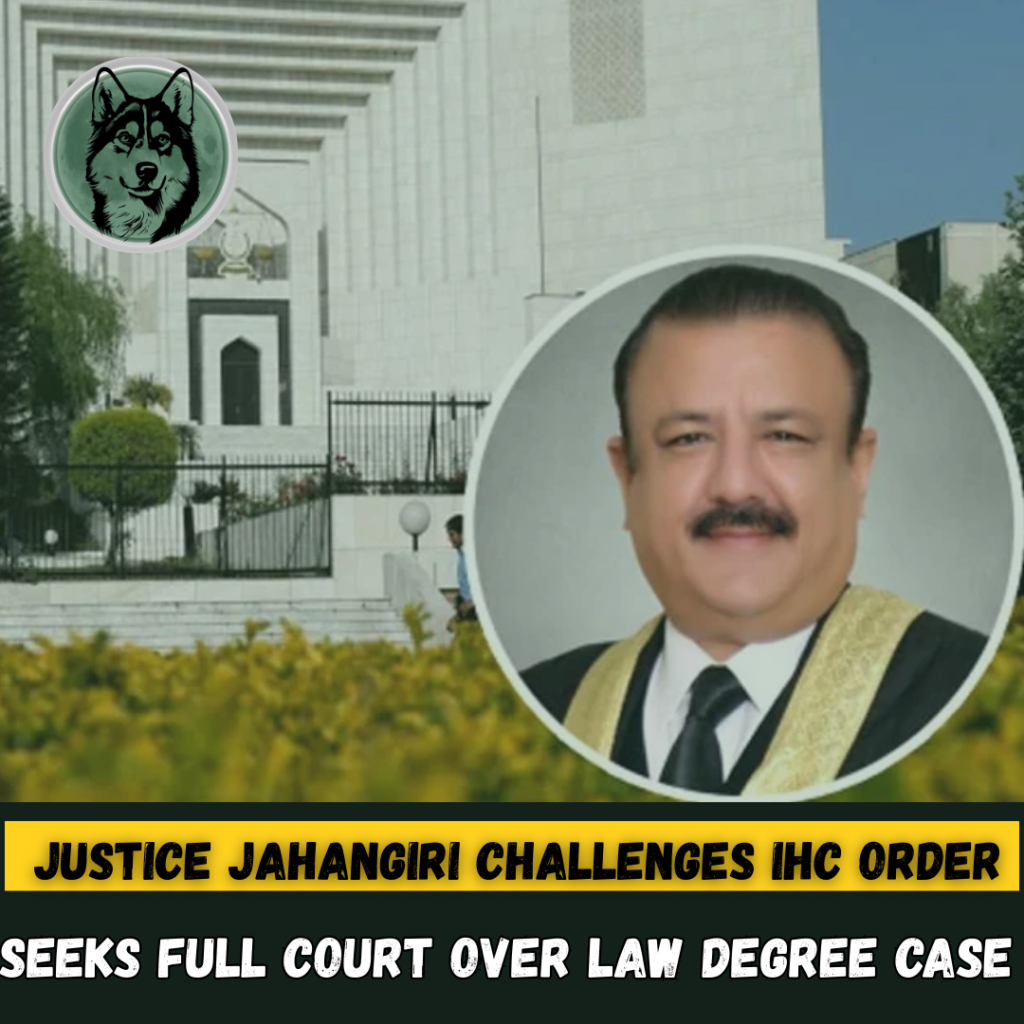
Justice alleges bias, questions due process, and seeks recusal of Chief Justice Dogar
Islamabad: Judicial Controversy Intensifies
A rare and unprecedented legal confrontation has emerged within Pakistan’s higher judiciary as Justice Tariq Mehmood Jahangiri has formally challenged an Islamabad High Court (IHC) order before the Federal Constitutional Court (FCC), contesting proceedings questioning his eligibility to hold office over an alleged invalid law degree.
In a parallel move, Justice Jahangiri has also filed an application within the Islamabad High Court itself, seeking the constitution of a full court and the recusal of Chief Justice Sardar Muhammad Sarfraz Dogar, along with other judges whose appointments remain under challenge.
Allegations of Bias and ‘Hasty’ Proceedings
In his application, Justice Jahangiri contends that the quo warranto petition questioning his appointment was taken up under both the administrative and judicial authority of Chief Justice Dogar, despite the fact that the chief justice’s own transfer and appointment to the IHC had previously been challenged by him and is currently sub judice before the Federal Constitutional Court.
He further alleges that the chief justice not only fixed the matter before a bench headed by himself but also issued restraining and procedural orders “in undue haste”, creating what he describes as an “appearance of bias”.
Justice Jahangiri maintains that such circumstances undermine public confidence and warrant a full court hearing, excluding judges whose appointments are directly or indirectly under challenge.
Challenge to Maintainability of Case
Separately, in his petition before the FCC, Justice Jahangiri has assailed the December 9, 2025 order of an IHC division bench, which declared the quo warranto petition maintainable and directed him to submit a reply within three days.
He argues that the order was passed without affording him a right to be heard, while individuals who were not parties to the case were allowed to address the court, a move he says violates Article 10A of the Constitution, which guarantees the right to due process and fair trial.
Disputed Facts and Jurisdictional Questions
At the heart of the controversy lies an alleged issue concerning Justice Jahangiri’s LLB degree, dating back several decades. He contends that the matter involves disputed questions of fact, which cannot be adjudicated by a high court without recording evidence.
Justice Jahangiri asserts that quo warranto proceedings do not empower a high court to conduct fact-finding trials, arguing instead that such matters fall within the jurisdiction of a trial court.
He has also objected to the IHC’s reliance on a report submitted by the University of Karachi, stating that its validity was neither examined nor was he given an opportunity to contest it.
Parallel Proceedings in Sindh High Court
The petition further highlights that the University of Karachi’s actions regarding his degree, including proceedings by its Unfair Means Committee and Syndicate are already under challenge before the Sindh High Court, where related proceedings have reportedly been suspended.
Justice Jahangiri maintains that his academic credentials have remained on record throughout his legal career, including during his enrolment as an advocate and subsequent judicial appointments, and denies all allegations against him.
Why This Case Matters: A Critical Analysis
This case goes beyond an individual judge’s credentials. Legal experts note that it raises fundamental questions about judicial process, impartiality, and institutional credibility.
The demand for a full court hearing underscores growing concerns about conflicts of interest, transparency in judicial appointments, and the scope of quo warranto jurisdiction. The outcome could set a significant precedent for how allegations against sitting judges are handled and by whom.