

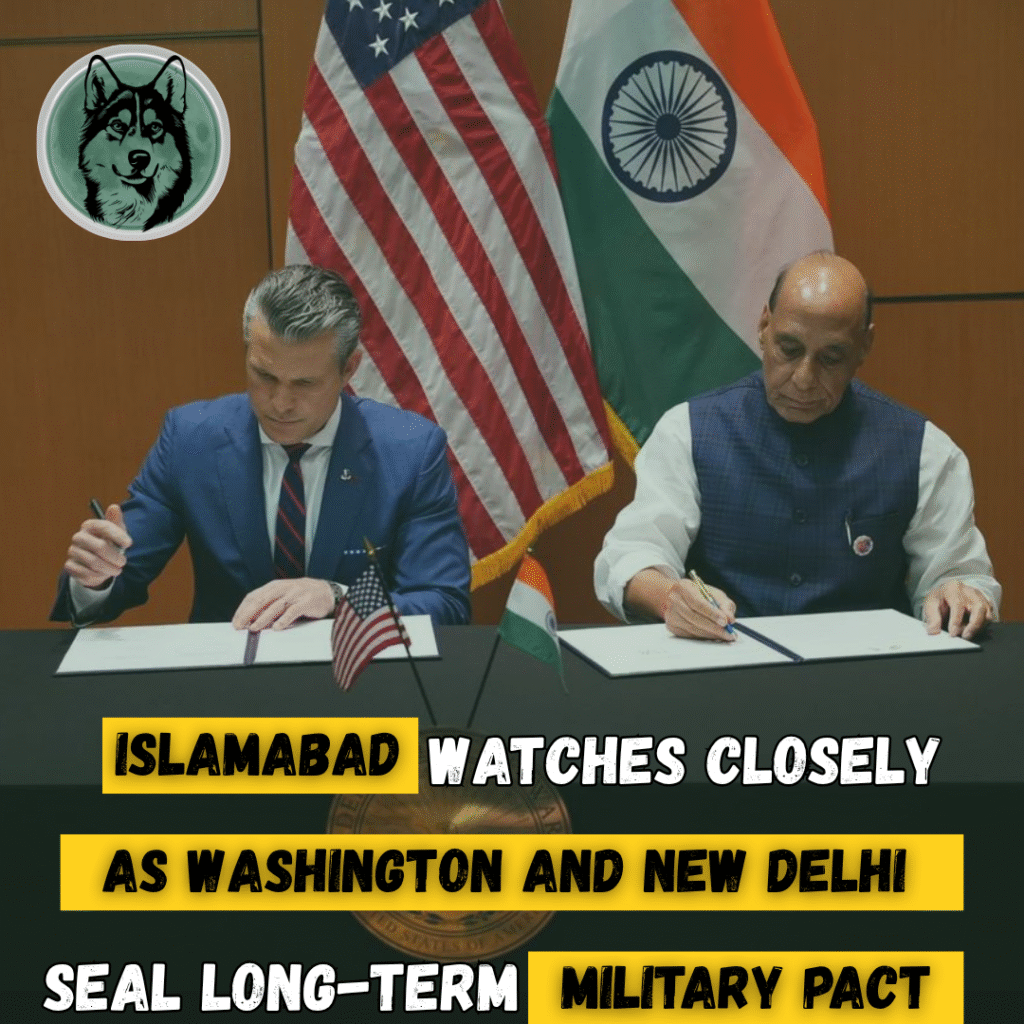
Islamabad views US-India defence framework as a move that could tilt regional military balance.
ISLAMABAD (Saturday, November 1, 2025): The United States and India have signed a 10-year defence framework agreement, a development that has drawn cautious concern in Pakistan, where observers view the pact as a potential challenge to regional strategic balance.
The framework, announced by US Defence Secretary Pete Hegseth, strengthens military coordination, information sharing, and technological collaboration between Washington and New Delhi even as President Donald Trump continues to publicly praise Pakistan and its Field Marshal for regional counterterrorism efforts.
“Our defence ties have never been stronger,” Hegseth posted on X after signing the agreement with Indian Defence Minister Rajnath Singh on the sidelines of the ASEAN Defence Ministers’ Meeting-Plus in Kuala Lumpur.
Contradictions in Trump’s Regional Approach
Political circles in Islamabad have expressed surprise at the timing of the pact, given Trump’s recent remarks lauding Pakistan’s sacrifices in the war on terror and his admiration for Pakistan’s military leadership.
Analysts note that while Trump repeatedly called Pakistan an “essential partner for stability in South Asia”, his administration has deepened strategic cooperation with India, a country long at odds with Pakistan over Kashmir and regional defence dynamics.
The move, many in Pakistan argue, reflects Washington’s double standard: appreciating Islamabad’s role in peace efforts while empowering New Delhi militarily.
Framework Seen as a Regional Power Shift
The 10-year framework lays the foundation for joint military exercises, defence technology exchange, and intelligence integration, underscoring America’s long-term commitment to India’s defence modernization.
Hegseth described the pact as “ambitious” and a “roadmap for deeper collaboration,” saying it would advance Indo-Pacific security a term many in Pakistan interpret as code for countering China and limiting Pakistan’s strategic space.
Pakistan’s Diplomatic Response
While Islamabad has not issued an official statement yet, diplomatic sources suggest that Pakistan’s Foreign Office is closely monitoring the situation. Officials said the agreement could disrupt South Asia’s delicate balance and undermine collective security mechanisms.
Foreign policy experts have urged the government to strengthen regional diplomacy and leverage Pakistan’s close ties with China, the Gulf, and Turkey to ensure its interests remain protected.
Broader Context of Strained US-India Ties
Ironically, the agreement comes after months of tension between Washington and New Delhi over Russian oil imports, trade tariffs, and visa restrictions.
In August, Trump raised tariffs on Indian goods to 50%, accusing New Delhi of fueling Moscow’s war effort through discounted crude purchases. Despite these tensions, the United States has now taken a long-term strategic leap with India, raising eyebrows across diplomatic quarters in Pakistan.
Pakistan’s Strategic Relevance
Observers in Islamabad believe the US cannot afford to ignore Pakistan’s geostrategic importance and defence capabilities.
Pakistan continues to play a key role in regional counterterrorism, Afghan stability, and China-led connectivity projects, making it an indispensable actor in South Asian geopolitics.
Analysts say the US-India pact will likely push Pakistan to further deepen defence cooperation with China, particularly under the CPEC security umbrella, while expanding its diplomatic outreach to maintain regional equilibrium.