



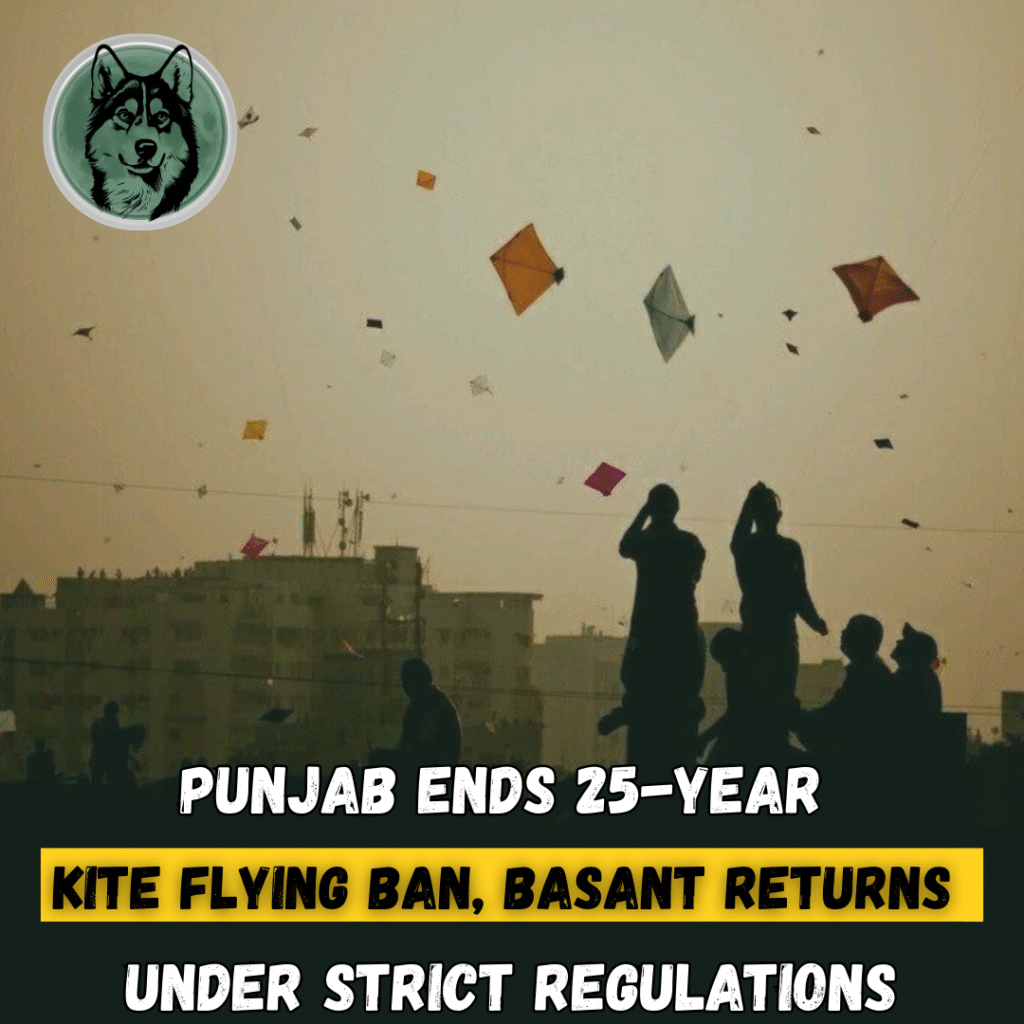
New ordinance allows regulated Basant festivities with heavy penalties for violations.
Punjab Lifts 25-Year Kite Flying Ban, Basant Celebrations Return
After a quarter-century, kite flying has officially returned to Punjab, marking the revival of the long-celebrated Basant festival. The provincial government has issued a detailed ordinance under which Basant festivities will be allowed under strict regulatory conditions.
The legislation, signed by Punjab Governor Sardar Saleem Haider, comes as part of Chief Minister Maryam Nawaz’s broader initiative to revive traditional cultural festivals across the province. Officials emphasized that this controlled return seeks to balance cultural celebration with public safety.
Stringent Penalties for Violations
The new law imposes heavy penalties for any violations of kite-flying rules:
- Imprisonment: 3 to 5 years
- Fines: Up to Rs2 million
- Non-bailable offences: All breaches will be treated as non-bailable, and authorities are empowered to search suspicious locations.
Ban on Dangerous Strings and Age Restrictions
To prevent accidents, only thread-based kite strings are permitted. The use of metal, chemical-coated, or sharp-edged strings remains strictly prohibited. Violators will face stringent punishment.
Children under 18 are barred from flying kites. Minors violating this law face:
- First offence: Rs50,000 fine
- Second offence: Rs100,000 fine
- Non-payment: Liability shifts to parent or guardian
Registration and QR Code Tracking
The ordinance introduces a transparent registration system for kite flying:
- Kite-flying associations must register with the district deputy commissioner
- Shopkeepers selling kites must be registered and linked to a QR code
- Each kite will carry a QR code identifying the seller
- Kite string manufacturers will also have QR-based identification
- Whistleblowers reporting violations will receive legal protection
Motorcycle Safety Measures
To prevent accidents historically caused by stray kite strings, the ordinance mandates strict motorcycle safety regulations within districts during Basant.
Cultural Revival With Public Safety in Mind
The government highlighted that the return of kite flying is not just about nostalgia, it represents a modern, regulated approach to preserving Punjab’s cultural heritage while protecting its citizens.
Basant’s comeback under these regulations aims to ensure that one of Punjab’s most cherished traditions can be enjoyed safely for generations to come.
Why Is Punjab’s Kite Flying Revival a Double-Edged Sword?
While the lifting of the 25-year ban on kite flying in Punjab is celebrated as a revival of cultural heritage, it raises critical questions about safety and enforceability. Despite strict rules, age restrictions, and QR-based tracking, past incidents of accidents and fatalities caused by kite strings suggest that effective monitoring will be a major challenge. The heavy penalties and non-bailable offences may deter some, but widespread compliance depends on rigorous enforcement and public awareness. Additionally, the introduction of technology-driven measures like QR codes may exclude smaller, informal sellers, potentially creating loopholes. Ultimately, while the ordinance balances tradition and safety on paper, its real-world success will depend on meticulous implementation and societal responsibility.