




Critics warn of environmental trade-offs, saying water guns offer only short-term relief.
LAHORE (Saturday, November 1, 2025) : As Punjab’s smog crisis intensifies, the provincial government’s latest response spraying thousands of litres of water across city roads has divided public opinion.
While authorities claim the initiative helps settle airborne pollutants and reduce particulate matter, environmental experts and citizens alike are questioning whether it’s a scientifically sound or sustainable solution.
Smog Guns in Action Across Punjab
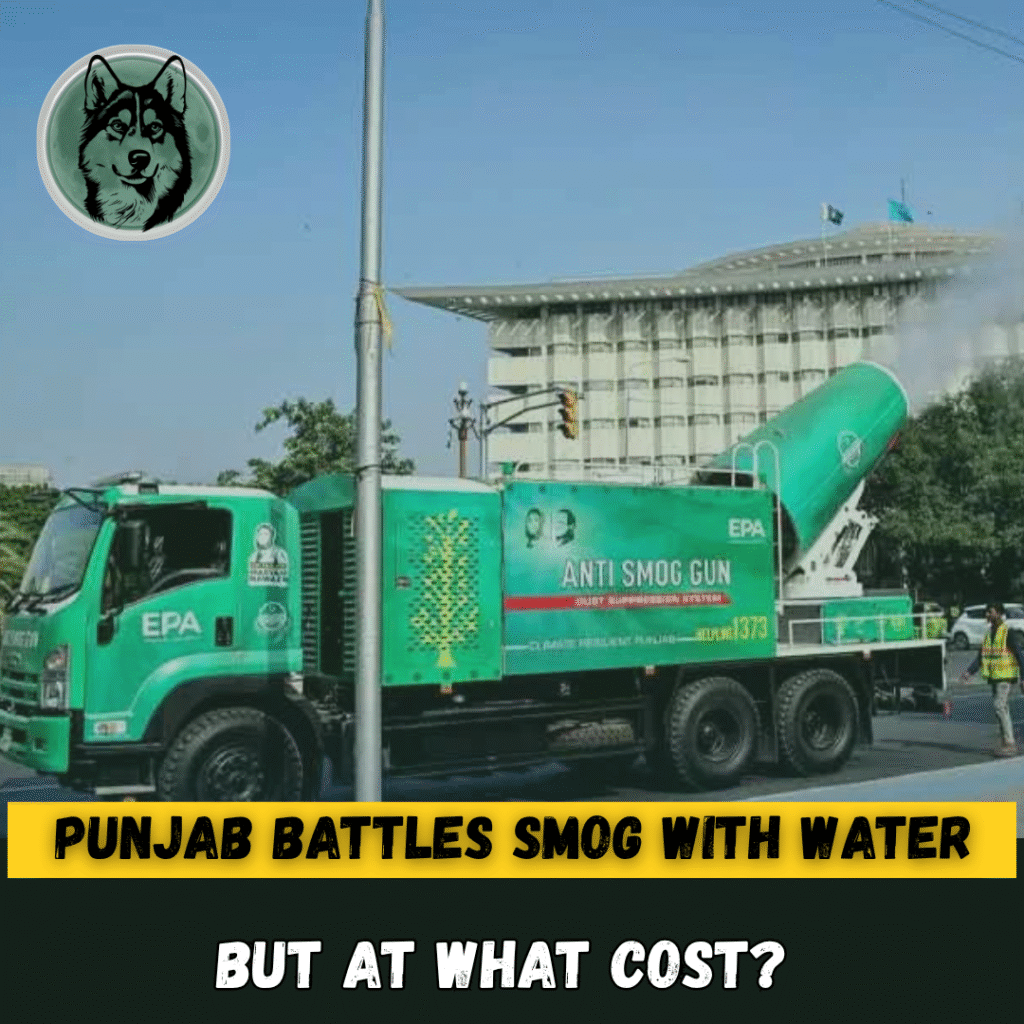
The Punjab government has deployed high-powered anti-smog guns in Lahore, Faisalabad, Gujranwala, and other major cities. Operating day and night, these machines spray fine mists of water into the air in an attempt to trap dust, soot, and toxins that contribute to the hazardous smog blanketing the province.
Officials say the spraying temporarily improves the Air Quality Index (AQI) and helps bring down particulate levels. However, the relief lasts for only a few hours before pollution levels rise again.
Concerns Over Wasted Water
The campaign comes at a time when Punjab’s groundwater levels are rapidly depleting, and several districts are already facing water stress.
Critics argue that using thousands of litres of clean water daily for a short-term drop in smog is unsustainable and environmentally risky.
“We’re fighting one environmental problem by worsening another,” said Sara Malik, a Lahore-based environmental researcher. “Water guns may look good for optics, but they don’t solve the root cause unchecked emissions and industrial pollution.”
Many residents have echoed similar frustrations online, calling the project a “temporary show” that diverts attention from long-term solutions such as stricter industrial regulation, electric public transport, and urban tree cover expansion.
Expert Opinions Divided
Environmental expert Muhammad Younus Zahid acknowledged the concerns but said progress often involves trade-offs.
“Some loss has to be borne for improvement,” he stated. “It’s better to make an effort even if not perfect than to sit idle as pollution worsens.”
Others believe the government’s approach could be improved through innovation. Several environmental scientists suggest integrating a water recycling system into anti-smog operations. This would allow for reusing sprayed water, reducing waste while still achieving partial pollution control.
Such a system, they argue, could strike a balance between clean air and water conservation, ensuring both environmental sustainability and public health benefits.
Beyond the Spray: Long-Term Solutions Needed
Experts stress that water guns alone cannot solve Punjab’s smog crisis.
The core causes including vehicle emissions, industrial smoke, agricultural residue burning, and poor urban planning must be addressed through policy enforcement, clean technology adoption, and public awareness.
Without comprehensive reforms, they warn, the smog will continue to choke cities no matter how many litres of water are sprayed into the air.