





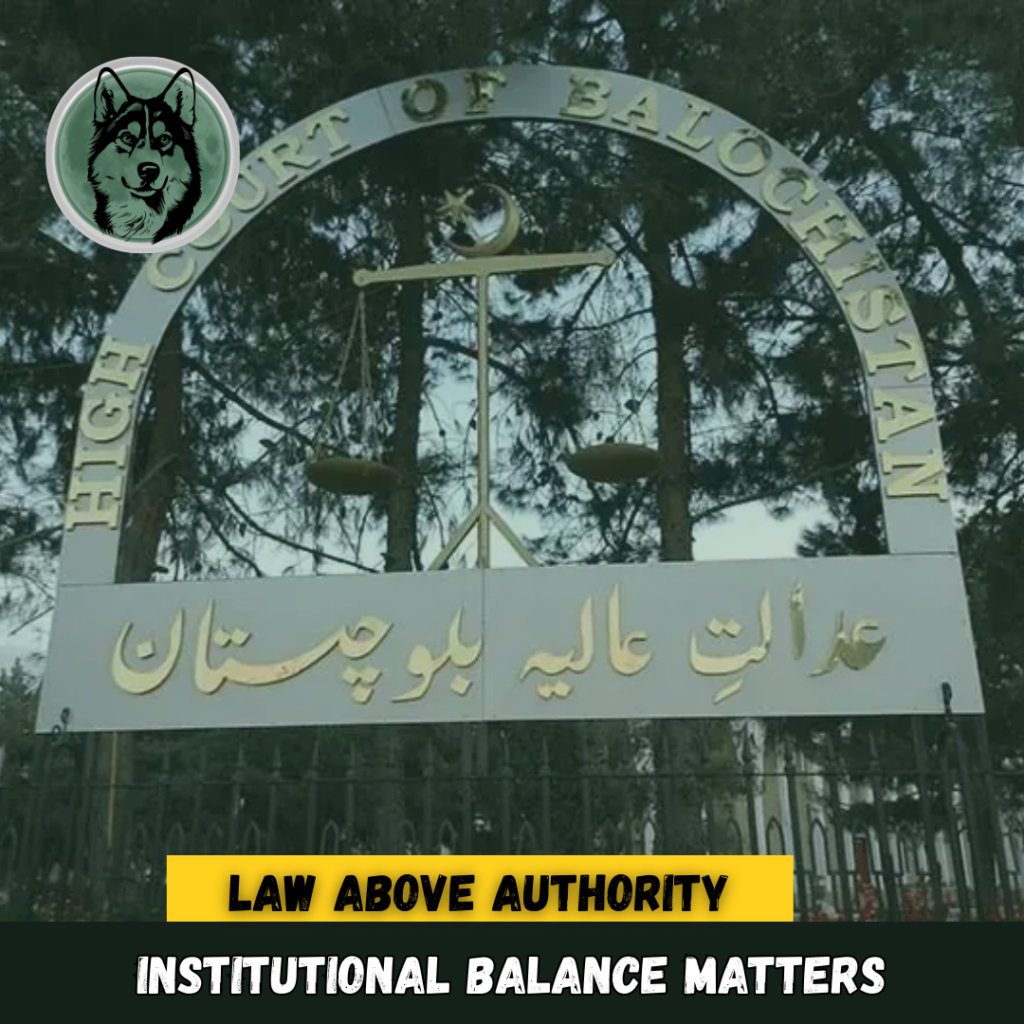
When executive power enters the courtroom, justice becomes vulnerable. The court’s intervention stands as a safeguard for citizens who rely on an independent judiciary
Balochistan High Court suspends a government order granting Justice of Peace powers to administrative officers, citing constitutional violations and risks to judicial independence.
BHC Halts Government Notification
The Balochistan High Court (BHC) on Monday suspended a provincial notification that granted Justice of Peace powers to divisional and district administration officers.
Bench Issues Immediate Order
A two-member bench comprising Chief Justice Muhammad Kamran Mulakhail and Justice Gul Hassan Tareen issued the suspension while hearing constitutional petitions.
Petitions Filed by Senior Lawyers
Senior advocate Rahib Khan Buledi, along with advocates Iftikhar Ahmed Langove and Abdul Baseer Kakar, challenged the government’s move before the high court.
Contested Notification Explained
The government issued the notification on December 30, 2025, under Section 22 of the Criminal Procedure Code (CrPC). It appointed commissioners, deputy commissioners, and assistant commissioners as Justices of Peace within their jurisdictions.
Expanded Judicial Powers
The order authorized these officials to exercise powers under Sections 22-A and 22-B of the CrPC, which involve issuing directions in criminal complaints and police matters.
Constitutional Objections Raised
Petitioners argued that the government acted without consulting or obtaining approval from the Chief Justice of the Balochistan High Court, violating Articles 175(3), 202, and 203 of the Constitution.
Threat to Judicial Structure
They stated that sessions judges already serve as ex-officio Justices of Peace and warned that transferring such authority to executive officers undermines judicial independence.
Court’s Interim Decision
The bench admitted the petitions, issued notices to the respondents, and ordered the suspension of the notification until the next hearing after the winter vacation.
Critical Analysis
1. Violation of Separation of Powers
Article 175(3) of the Constitution demands a strict separation between executive and judiciary. By assigning judicial functions to administrative officers, the government blurred institutional boundaries. The court’s suspension restores constitutional order.
2. Risk to Judicial Independence
Sections 22-A and 22-B empower Justices of Peace to direct police actions. Granting this authority to executive officials creates a risk of administrative pressure on criminal proceedings, weakening impartial justice.
3. Creation of a Parallel System
Sessions judges already perform Justice of Peace duties under law. Appointing executive officers to the same role without judicial oversight introduces conflicting authority and procedural confusion.
4. Lack of Procedural Safeguards
Although Section 22 of the CrPC allows appointments in rural areas, it requires defined rules and limits. The impugned notification failed to establish accountability, oversight, or boundaries, enabling unchecked discretion.
5. Long-Term Institutional Impact
If implemented, the notification could normalize executive control over judicial functions. This would erode public confidence in courts, weaken due process, and damage the credibility of Pakistan’s justice system. The court’s stay prevents a dangerous precedent.