





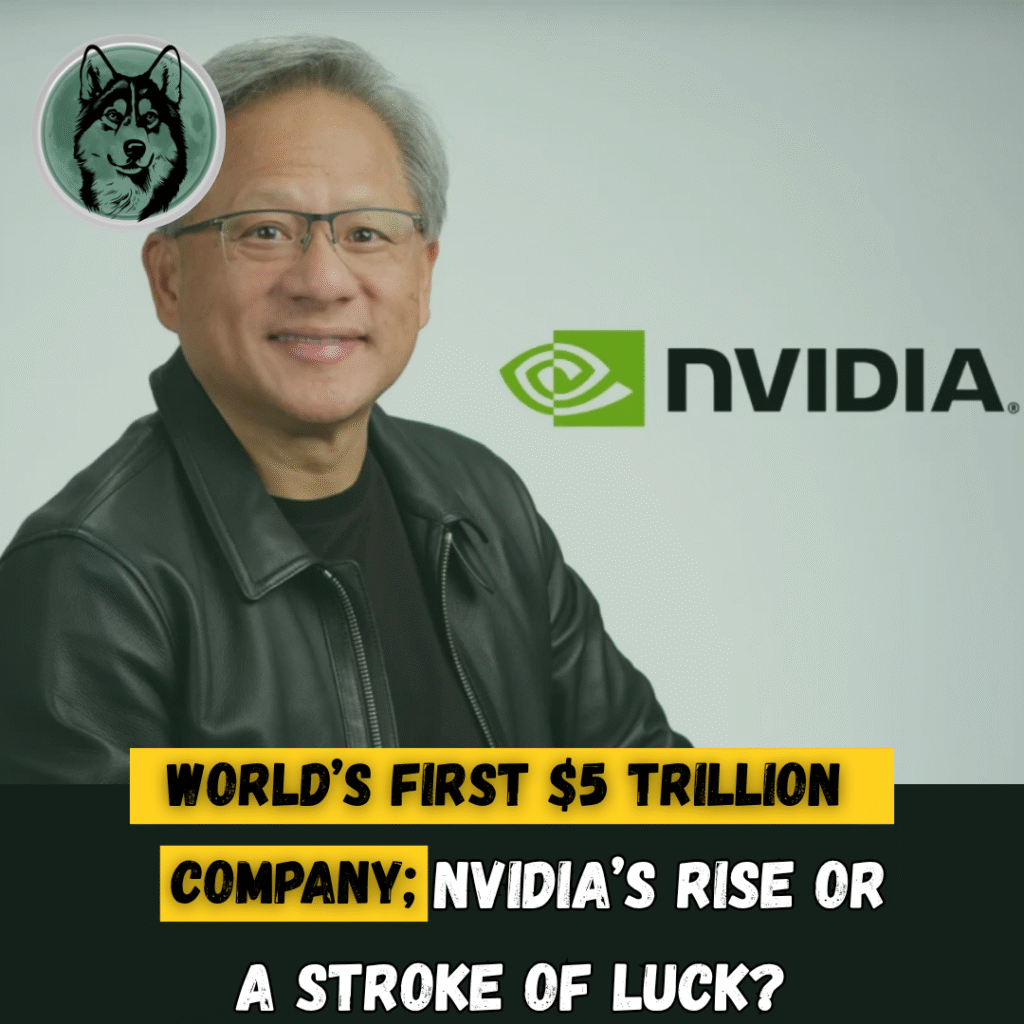
The GPU giant’s journey from gaming roots to AI leadership redefines modern tech dominance.
A Historic Milestone in Tech
Nvidia has officially become the world’s first $5 trillion company, its market capitalization soaring past $5.12 trillion, a record that cements its dominance at the heart of the global artificial intelligence revolution.
The meteoric rise follows a series of unprecedented growth spurts: Nvidia surpassed $3 trillion earlier this year, then $4 trillion within months, and now stands alone above the $5 trillion mark, a valuation once thought unattainable outside the energy or finance sectors.
While CEO Jensen Huang attributes this success to decades of foresight and strategic vision, analysts suggest that Nvidia’s ascent is also a story of perfect timing, market positioning, and a measure of luck.
Huang’s “Accelerated Computing” Vision
At the recent GTC Conference, Huang declared that Nvidia had long predicted the end of traditional chip efficiency scaling and pivoted early toward “accelerated computing.”
“We made this observation a long time ago, and for 30 years we’ve been advancing this form of computing,” Huang said, referring to Nvidia’s creation of the GPU and its CUDA software platform.
The CEO framed Nvidia’s evolution as a deliberate, visionary path toward AI dominance. Yet, tech historians and analysts caution that this story may be more retrospective mythmaking than premeditated genius.
The Untold Early Struggles
In its early decades, Nvidia was primarily a graphics company serving the gaming industry. Its GPUs powered visual computing, not artificial intelligence.
During the 2000s, the company explored GPU applications in video encoding, physics simulations, protein folding, and even data mining, most of which failed commercially.
It wasn’t until 2012 that Nvidia began associating its technology with AI and machine learning, under the emerging concept of general-purpose GPU (GPGPU) computing.
That gradual transition combined with relentless R&D and community-building around CUDA allowed Nvidia to become the default choice for AI researchers once deep learning models exploded in popularity around 2016.
A Mix of Innovation and Fortune
While Nvidia’s dominance today reflects undeniable engineering excellence, experts agree that timing and market conditions played a crucial role.
When AI research entered its deep learning phase, Nvidia’s hardware ecosystem was already optimized for the heavy computational demands of neural networks. This fortuitous alignment made its GPUs indispensable, from training ChatGPT-like language models to powering autonomous vehicles and robotics.
In short, Nvidia didn’t just predict the AI boom, it was ready when the world finally caught up.
What Nvidia’s Rise Means for the Future
Nvidia’s success story underscores a broader truth in technology: sustainable dominance requires a balance of foresight, adaptability, and luck.
As the world embraces AI in every sector, from healthcare to defense, Nvidia’s chips sit at the core of that transformation. However, experts caution that if the current AI frenzy cools, Nvidia’s trillion-dollar valuation could face significant corrections.
Still, if artificial intelligence continues to evolve as the defining technological wave of the century, Nvidia’s $5 trillion milestone may not mark a peak but a beginning.