



Experts warn of “public health emergency” as smog blankets Punjab’s urban centers.
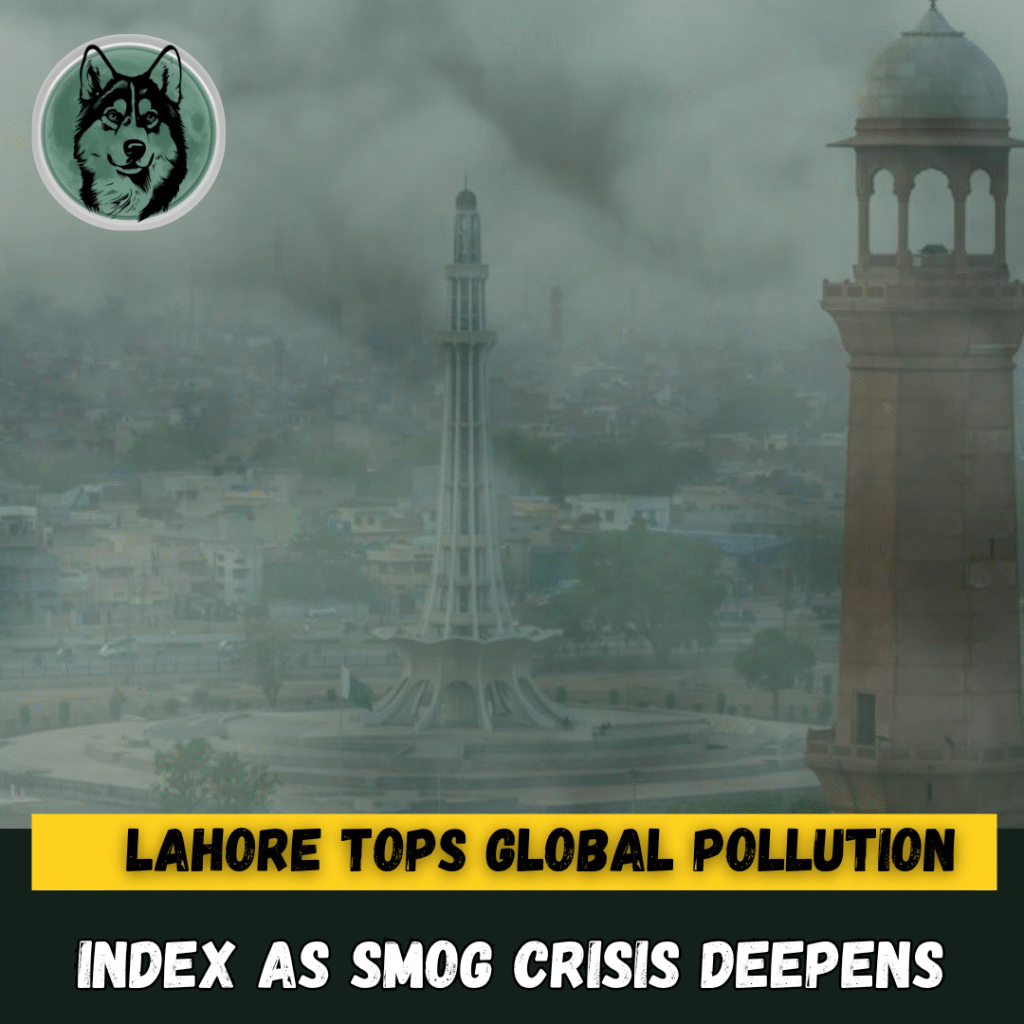
LAHORE — The city once again wore the unwelcome crown of being the most polluted city in the world on Monday, as a dense layer of smog engulfed the provincial capital, pushing air quality indicators to life-threatening levels.
According to real-time data from IQAir, Lahore’s Air Quality Index (AQI) climbed to an alarming 312, while the concentration of PM2.5 — the most dangerous airborne particulate matter — reached 190.5 micrograms per cubic meter, nearly 25 times higher than the World Health Organization’s safe limit.
Environmental experts described the situation as a “public health emergency”, warning that prolonged exposure to such toxic air could have severe health consequences for millions.
Hazardous Zones Across the City
The smog’s severity varied across neighborhoods, but several areas crossed into catastrophic pollution levels.
- The City School, Allama Iqbal Town, recorded an AQI of 505, a level associated with emergency health warnings.
- Fauji Fertilizer Pakistan and The City School Shalimar Campus also reported AQIs of 525 and 366, respectively.
With pollutants trapped close to the ground due to zero wind movement (0 km/h) and 50% humidity, visibility in many parts of the city dropped drastically, leaving residents gasping for relief.
Punjab’s Urban Centers Suffocate
The pollution crisis was not confined to Lahore. The national city ranking revealed that Pakistani cities dominated the global list of most polluted areas, with Faisalabad (AQI 439) and Multan (AQI 438) also recording hazardous levels.
Other urban hubs — including Gujranwala, Bahawalpur, and Sialkot — featured prominently among the world’s most polluted cities, underscoring a province-wide environmental crisis.
At 10 p.m. Monday, Lahore’s AQI of 272 kept it ahead of Delhi (AQI 220) and Kolkata (AQI 170), cementing its grim position atop the global pollution index.
Health Advisory and Government Response
Authorities have urged residents, especially children, the elderly, and individuals with respiratory issues, to stay indoors and minimize outdoor activity.
Doctors warn that even brief exposure to such conditions could trigger breathing difficulties, eye irritation, asthma attacks, and cardiovascular stress.
While emergency measures — including restrictions on industrial emissions and vehicle checks — have been discussed, enforcement remains inconsistent. Officials from the Punjab Environmental Protection Department admit that crop burning, traffic emissions, and industrial smoke continue to fuel the crisis every winter.
Annual Environmental Catastrophe
Lahore’s smog problem has evolved into an annual environmental disaster, driven by a combination of vehicular emissions, industrial waste, and post-harvest agricultural fires. Experts argue that without long-term policy enforcement and regional cooperation, the situation is unlikely to improve. “We’re not just breathing bad air; we’re breathing poison,” remarked one environmental scientist.