




White House move signals new era of nuclear deterrence policy.
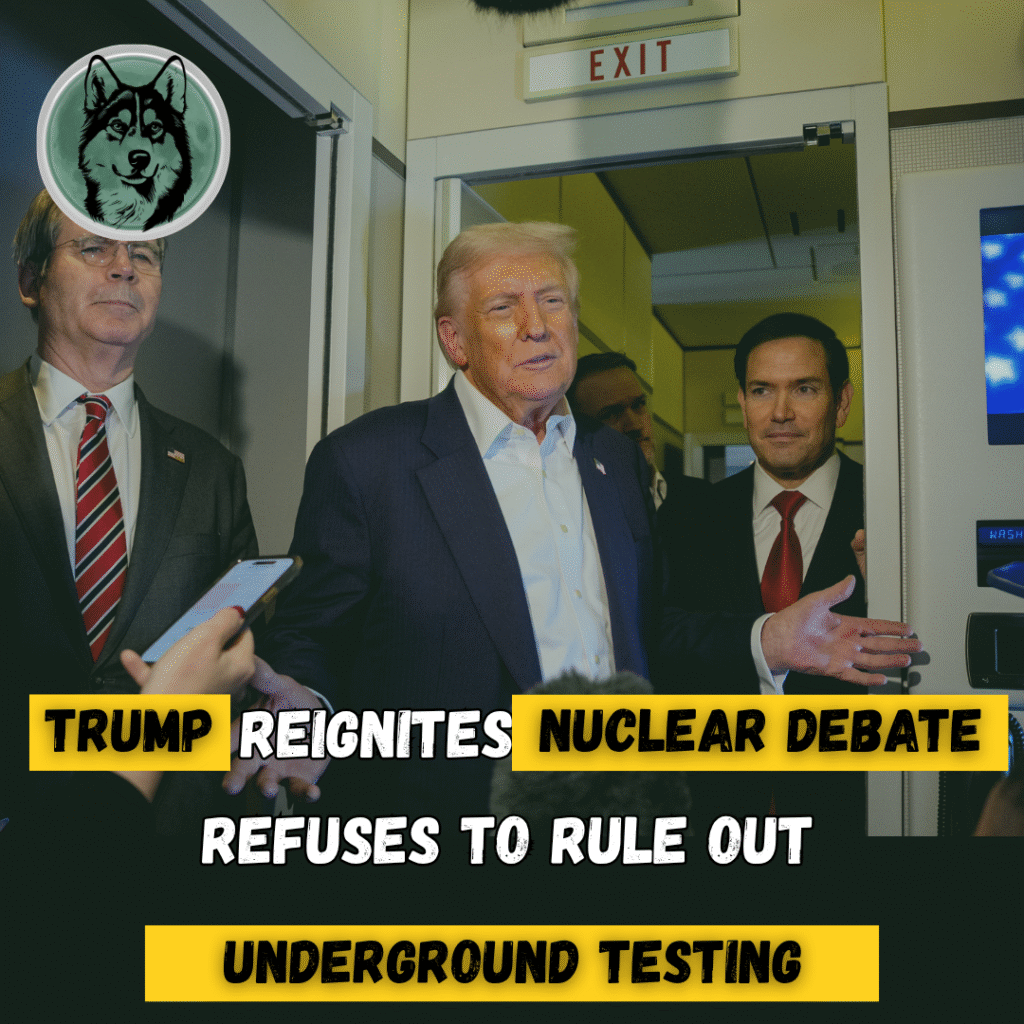
WASHINGTON / PALM BEACH (November 1, 2025 | Saturday): President Donald Trump has declined to rule out the possibility of underground nuclear tests, saying the United States will not hold back if other nuclear powers continue testing their weapons.
Speaking to reporters aboard Air Force One en route to Palm Beach, Florida, Trump was asked directly whether the United States would resume underground nuclear tests.
“You’ll find out very soon, but we’re going to do some testing,” the president said. “Other countries do it. If they’re going to do it, we’re going to do it, OK?”
Restart After 33 Years
Trump’s comments came a day after he announced that he had ordered the US military to restart nuclear weapons testing after a pause of more than three decades. The statement, made on social media while aboard Marine One, appeared aimed at China and Russia, both of whom have recently modernized their nuclear arsenals.
The decision signals a sharp policy reversal from the long-standing nuclear testing moratorium observed by Washington since 1992.
Unclear Scope of Testing
It remains unclear whether the president’s directive involves nuclear-explosive testing conducted by the National Nuclear Security Administration or flight testing of nuclear-capable missiles. Analysts warn that either step could undermine decades of nuclear restraint and spark a global arms race.
Pentagon Justifies the Move
US Defense Secretary Pete Hegseth, speaking during a trip to Malaysia, defended the move as a “responsible” measure to maintain nuclear deterrence.
“We’re moving out quickly,” Hegseth said, adding that the Pentagon was coordinating with the Department of Energy on implementation.
Opposition Mounts
However, domestic backlash was swift. Representative Dina Titus, a Democrat from Nevada home to the historic Nevada Test Site introduced legislation on Friday to block funding for any resumption of nuclear explosive testing.
Titus, who authored a history of US nuclear experimentation, warned that restarting such tests could provoke rival nations and “put Nevadans back in the crosshairs of toxic radiation and environmental destruction.”
Global Context
No nuclear power except North Korea in 2017 has conducted explosive nuclear testing in more than 25 years. Experts fear that the US decision may unravel decades of international non-proliferation efforts and could trigger reciprocal testing by Russia and China, leading to renewed Cold War-style tensions.
Background
The Comprehensive Nuclear-Test-Ban Treaty (CTBT), though never ratified by the US Senate, has effectively curbed explosive testing since the 1990s. Washington’s return to testing could weaken the global treaty system and embolden nations like Iran and North Korea to expand their own programs.