



Aid groups warn of catastrophic conditions as thousands flee El-Fasher following RSF control.
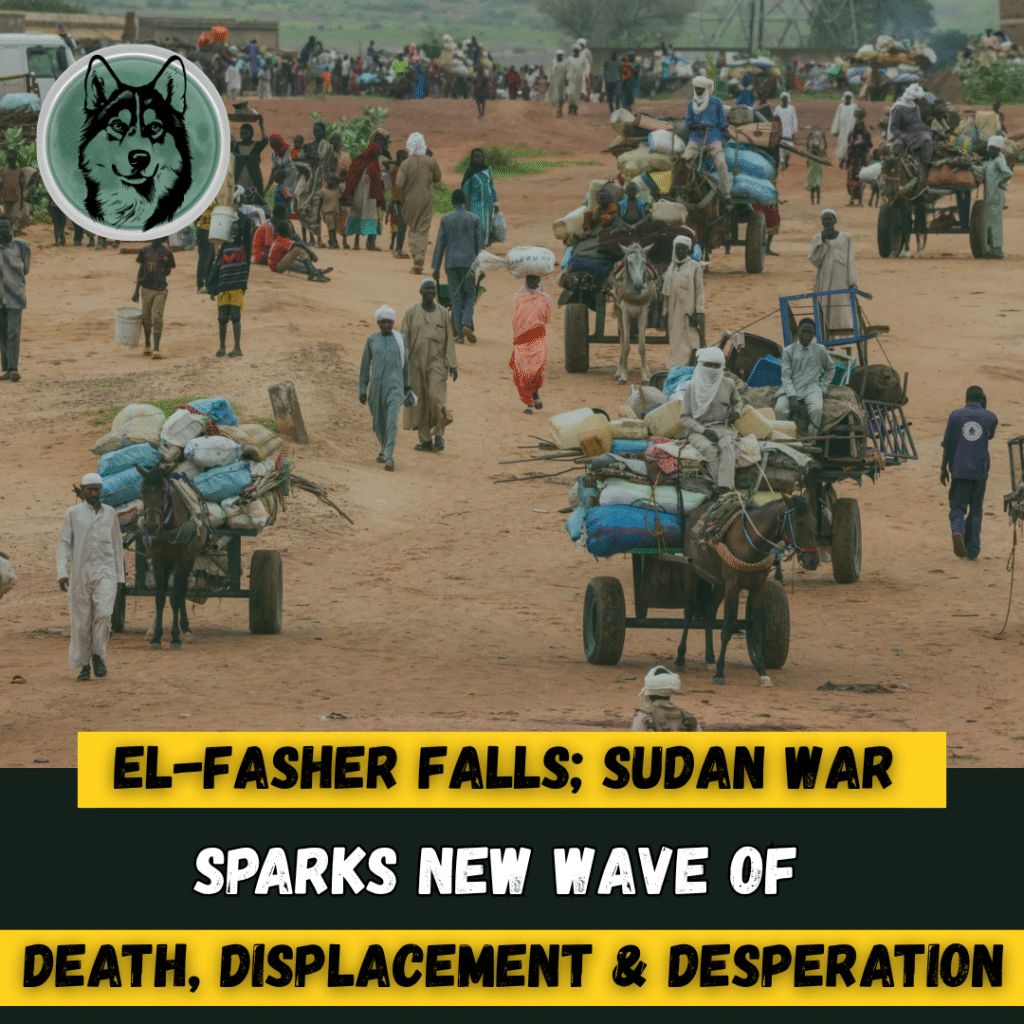
Millions of people across war torn Sudan, particularly in the western Darfur region, are enduring one of the worst humanitarian crises in recent memory. After an 18 month siege, the Rapid Support Forces (RSF) have seized control of El Fasher, the capital of North Darfur, leading to widespread killings, starvation, and mass displacement.
Cities in Ruin, Civilians Missing
A week after the RSF takeover, the situation remains dire.
Tens of thousands of civilians are still trapped inside El Fasher, while thousands more are missing or unaccounted for after fleeing the city amid intense fighting.
Only a fraction of those who escaped on foot have managed to reach Tawila, a small town about 50 kilometers away, now overflowing with desperate families seeking food and shelter.
Aid workers on the ground describe the situation as “catastrophic.”
According to Caroline Bouvard, Sudan country director for Solidarites International, there is a complete communication blackout from within El Fasher. Information is trickling in only from surrounding areas where nearly 15,000 people remain stranded with no access to aid.
“People are stuck on roads and in villages still inaccessible due to security reasons,” said Bouvard. “We urgently need humanitarian corridors to reach them or transport them to safety.”
Horrors on the Road to Safety
Survivors recount horrific stories, mass executions, torture, sexual violence, and ransom kidnappings by armed groups patrolling escape routes. Many fled under constant gunfire, forced to abandon family members along the way.
Those who survived now sleep in the open, without food, clean water, or medical care. Aid camps like Al Dabbah, in Sudan’s Northern State, are overwhelmed, housing families who have been displaced for weeks, with thousands more still arriving each day.
Conditions in the camps are deteriorating rapidly. Aid workers warn of disease outbreaks and critical shortages of supplies. The lack of communication with El Fasher has left agencies blind to the full extent of the disaster.
Calls for International Action
The United States, Saudi Arabia, United Arab Emirates, and Egypt, key mediators in the conflict, have condemned the killings and urged all parties to allow immediate humanitarian access.
The U.S. State Department issued a strong statement, urging the RSF to cease ethnic violence and warning that “the tragedy of El Geneina must not be repeated.”
American lawmakers are also pressing for tougher measures.
Senator Jim Risch, chairman of the Senate Foreign Relations Committee, has called for the RSF to be declared a foreign terrorist organization, citing their pattern of mass atrocities and civilian massacres across Darfur.
Despite mounting pressure, neither the Sudanese Armed Forces (SAF) nor the RSF appear willing to negotiate a ceasefire. Mediators’ roadmaps have so far failed, leaving millions of Sudanese civilians at the mercy of armed groups.
Sudan on the Edge
The fall of El Fasher, the last major city in western Sudan not under RSF control, marks a devastating new chapter in the nation’s civil war.
Entire communities have vanished, infrastructure is destroyed, and famine looms over displaced families.
Humanitarian agencies warn that without immediate global intervention, Sudan could witness mass starvation and further ethnic cleansing in the coming months.
As night falls over Darfur, the silence is filled only with fear, and the world’s inaction continues to echo louder than the gunfire.