


Pakistan supports delisting of Syrian leaders from UN sanctions to facilitate national rebuilding.
UNITED NATIONS : Pakistan has called on India to fully comply with the Indus Waters Treaty (IWT), warning that New Delhi’s unilateral suspension of the agreement earlier this year represents a “deliberate weaponisation of shared natural resources” that threatens both ecosystems and livelihoods across South Asia.
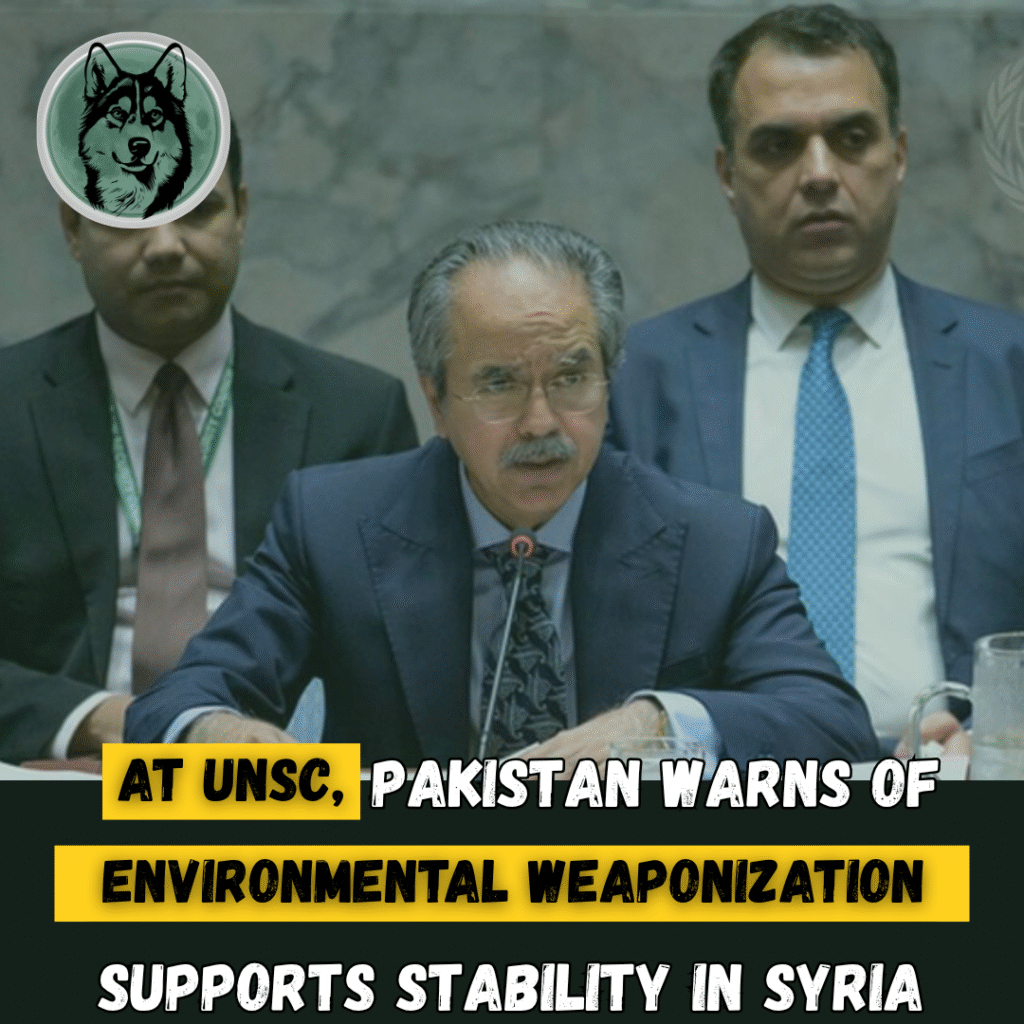
The appeal was made by Ambassador Asim Iftikhar Ahmad, Pakistan’s Permanent Representative to the United Nations, during a UN Security Council briefing on the environmental impact of armed conflict and the growing link between climate and security risks.
“India’s unlawful unilateral decision undermines the letter and spirit of the treaty, disrupts data sharing, and endangers millions who depend on these waters for food and energy security,” Ahmad said.
“Such acts weaken confidence in international water law and set a precedent for resource-based coercion elsewhere.”
India’s Suspension ‘Violates Treaty and Global Trust’
The 1960 Indus Waters Treaty, mediated by the World Bank, governs water sharing between India and Pakistan across six rivers in the Indus basin. It grants control of the western rivers (Indus, Jhelum, Chenab) to Pakistan and the eastern rivers (Ravi, Beas, Sutlej) to India.
Disputes over India’s hydropower projects on western rivers have long been contentious, culminating in arbitration before the Permanent Court of Arbitration (PCA) in The Hague.
In 2025, the PCA reaffirmed the treaty’s continuing validity and ruled that no party has the right to unilaterally suspend or modify its provisions.
“No provision of the treaty allows unilateral suspension or modification,” Ambassador Ahmad reiterated.
“We therefore expect full respect for the treaty and an early return to compliance through established mechanisms.”
Climate, Conflict, and Environmental Security
Linking environmental degradation with regional instability, Ahmad warned that armed conflict and climate stress including rising sea levels and extreme weather threaten the survival of vulnerable nations.
He urged the Security Council to:
- Integrate environmental safeguards into peacekeeping and reconstruction missions.
- Promote early conflict prevention mechanisms related to natural resource disputes.
- Establish grant-based climate and biodiversity financing, ensuring it does not increase debt or replace existing aid.
“Environmental damage in conflict is not collateral — it can be a multiplier of insecurity,” Ahmad cautioned, emphasizing the need for cooperative frameworks that transform shared resources into tools of peace rather than conflict.
Pakistan Backs UN Resolution to Delist Syrian Leaders
In a related development, Pakistan voted in favour of a UN Security Council resolution to delist Syrian President Ahmed al-Sharaa and Interior Minister Anas Khattab from the 1267 sanctions committee, calling the move a step toward national stability and reconstruction.
Ambassador Ahmad said the decision aimed to help Syria transition toward peace after years of civil war, adding that sanctions relief must accompany dialogue and a Syrian-led political process.
“The Syrian people have suffered for more than a decade. Today’s vote is a welcome step to support their transition toward peace and stability,” he said.
The ambassador also highlighted ongoing terrorist threats and the need for central governance in Syria to restore order. He reaffirmed Pakistan’s support for inclusive nation-building, aligning with the Security Council’s broader efforts to rebuild Syria’s institutions and confidence in governance.
Pakistan’s Dual Message: Peace Through Law and Cooperation
Through its twin calls urging India to respect international water treaties and supporting Syria’s post-war rehabilitation Pakistan positioned itself as a proponent of lawful, cooperative global engagement.
At the UNSC session, Ambassador Ahmad underscored that shared natural resources and environmental stability must become bridges for cooperation, not tools for coercion.
“We must move from conflict to collaboration from weaponisation to sustainability,” he concluded.
One Response
A crucial reminder that regional peace depends on respecting international treaties. Strong message by Pakistan at the UNSC